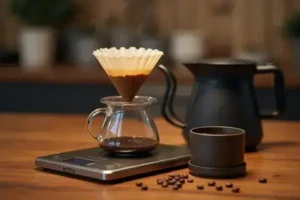
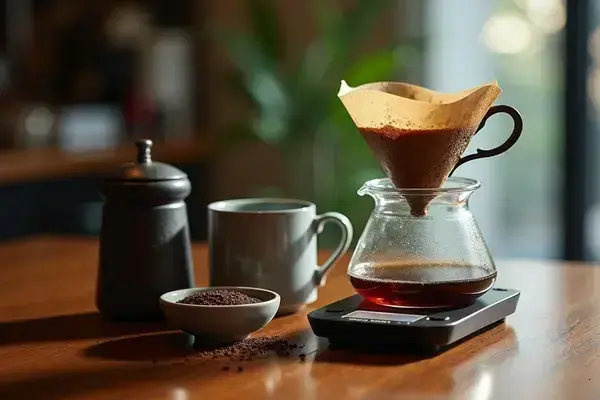
Picture waking up, excited for that first sip—only to brew a cup that tastes weak or hits like jet fuel. We’ve all been there. Nailing the perfect pour over ratio feels elusive until you finally crack the code.
Too much guesswork and every brew turns into roulette. One morning, it’s watery disappointment; the next, a face-puckering wallop. It’s frustrating when your ritual doesn’t deliver the balance you crave, especially when good beans aren’t exactly cheap.
By the end of this guide, you’ll confidently dial in your pour over coffee ratio guide—no apps, charts, or barista training needed. Ready to find that sweet spot for your daily cup? Keep reading—your new favorite flavor might be just a ratio away.
Why The Coffee To Water Ratio Matters More Than You Think
Ever wonder why a cup brewed at your favorite local café tastes balanced and sweet — but your home attempts often swing toward sour, bitter, or oddly flat? Here’s the thing: it’s not just the beans or fancy gear. It’s your coffee-to-water ratio doing the heavy lifting, controlling how those flavors make or break your brew.
Getting this ratio right isn’t about snobbery or perfectionism. According to the Specialty Coffee Association (SCA), the recommended standard for ideal extraction is a ratio of 1:16 — that’s one part coffee for every sixteen parts water. Drift away from this benchmark and you’ll notice it fast. Too concentrated and you’ll get overpowering bitterness. Too dilute, and complexity disappears.
💡 Pro Tip: Use a digital kitchen scale instead of scoops or spoons for accuracy. Even a slight variation of a single gram can noticeably shift the taste, especially with premium single-origin beans, as noted by Counter Culture Coffee’s brewing guides.
In practice: imagine you’re brewing a morning cup with 20 grams of freshly ground coffee. Add 320 grams of filtered water, and you’ll hit that 1:16 ratio. Now try 250 grams — suddenly the coffee becomes dense and heavy, the acidity sharp. Or use 400 grams of water, and the cup thins out, falling flat. That’s how crucial this balance is, no matter what coffee or filter you use.
| Ratio | Flavor Profile | Common Uses |
|---|---|---|
| 1:15 | Richer, syrupy, intense | Espresso-like, bold drip |
| 1:16 | Balanced, sweet, complex | Specialty pour over, SCA standard |
| 1:17+ | Lighter, delicate, bright | Subtle single origins, bigger mugs |
Picture this scenario: you’ve invited friends for brunch and want every cup to shine. You dial in the SCA’s recommended ratio. Those nuanced chocolate and floral notes pop — everyone’s asking what changed from last time. That’s the power of precision: it translates directly to taste.
But there’s one detail most owners completely overlook until it’s too late…
Common Pour Over Mistakes And How To Fix Them
Ever ended up with a cup that’s weirdly sour or painfully bitter, even though you followed a trusted recipe? You’re not alone. Pour over coffee is famously finicky — but most mistakes come down to small details and a few common misconceptions.
- Inconsistent grind size: If your grind looks like tiny boulders mixed with dust, you’re stacking the odds against yourself. A uniform grind helps water extract flavor evenly. Burr grinders, especially from brands like Baratza or Timemore, deliver this consistency better than blade grinders.
- Water that’s too hot or too cold: Brewing with boiling water seems logical, but anything above 205°F can pull out nasty bitterness. Go below 195°F and you’ll miss lots of flavor. The National Coffee Association recommends around 200°F for optimal extraction.
- Poor pouring technique: Dumping all the water at once, or wildly pouring over one spot, ruins even the best beans. You need a controlled, spiral motion so all grounds extract the same way.
- Neglecting the bloom: Pour a little water (about twice your coffee quantity) and wait 30–45 seconds. This lets trapped CO₂ escape, preventing sourness and uneven brew.
- Wrong coffee-to-water ratio: Using eyeballed scoops instead of a scale causes wild variations from cup to cup. Even a one gram shift can make a surprising difference with specialty coffee.
⚠️ Important Warning: Using unfiltered tap water can introduce unwanted minerals and alter the intended flavor profile of your beans. Use filtered water whenever possible to make sure your coffee’s taste shines—this is recommended by the Specialty Coffee Association’s water quality standards.
In practice: imagine you’re brewing before work, a little rushed. You skip the bloom, hurry the pour, and your grinder’s set too coarse. The result? Thin, acidic coffee that leaves you disappointed as you run out the door. Slowing down to check these details — even just two of them — can completely transform the cup.
- Check your grinder and dial in a medium-fine setting.
- Heat filtered water to about 200°F.
- Place your brewer and filter over your mug, rinse with hot water, and discard the rinse.
- Weigh out both coffee and water for your chosen ratio.
- Pour a small amount of water to bloom, wait 30-45 seconds, then continue pouring in slow, controlled spirals.
- Let the brew fully drain—don’t rush it!
What actually works might surprise you…
How To Experiment With Ratios For Personal Taste
So how do you actually discover your dream cup? The beauty of pour over is all about adjusting for taste — not just following a strict recipe. What’s bold for you may be harsh to someone else, and vice versa. Here’s how you can experiment with ratios and truly tailor every brew.
Let’s break it down. Anytime you change the amount of coffee or water, you’re tuning sweetness, body, and acidity. Small tweaks go a long way. Start with a baseline (like 1:16) and only adjust one variable at a time so you notice what changes. The Specialty Coffee Association encourages this methodical approach because our palates are unique and influenced by everything from water chemistry to roast freshness.
- Choose a starting ratio — for most, 1:15, 1:16, or 1:17 is a good launchpad.
- Weigh both coffee and water with a digital scale for precision.
- Keep every other variable (grind size, water temperature, pour style) the same.
- Brew a cup, jot down tasting notes — is it too strong, too weak, too sour, or just right?
- Change only the water amount next time, maybe move from 1:16 to 1:15 for a richer mouthfeel or up to 1:17 for a lighter cup.
- Repeat, track, and compare. If you have a friend tasting with you, compare notes and preferences for reference.
💡 Pro Tip: Use a simple tasting sheet. Write down flavor notes, mouthfeel, and even your mood on brewing days — unexpected details can influence what you love in your cup. The World Coffee Research Sensory Lexicon is a fantastic reference for building tasting vocabulary.
In practice: imagine you try a 1:15 ratio on Monday — it feels punchy but just a touch bitter. By Friday, you land on 1:16.5 and hit a sweet, mellow spot that finally makes the good stuff come forward. That’s your ratio, unique to your beans, water, and taste.
But finding your go-to cup is only half the story — the tools you use have just as much influence as any ratio change…
The Best Tools To Help You Measure Accurately
Ever get that nagging feeling your pour over’s off by just a little—maybe too strong, or mysteriously weak? That’s almost always a measurement issue. Even expert baristas rely on great tools to ensure their ratios and brews are dead on, every single time.
| Tool | Best For | Key Features |
|---|---|---|
| Hario V60 Drip Scale | Precise ratios, timing | 0.1g increments, built-in timer, compact |
| Acaia Pearl S | Advanced pro brewing | Ultra-fast response, Bluetooth, app integration |
| Fellow Atmos Canister | Fresh bean storage | Vacuum seal, air-tight, visual freshness indicator |
Here’s the thing: basic kitchen scales just don’t cut it—most round to the nearest 5 grams and aren’t sensitive enough. Coffee brewing is delicate. Those “extra” grams or missing milliliters? They change everything. Premium scales, like the Acaia Pearl S or Hario V60, are trusted by the World Brewers Cup and recommended by the Specialty Coffee Association. They ensure you hit your numbers, with no margin for error.
💡 Pro Tip: If you want truly pro results at home, always measure both your beans and your water. And don’t forget: pre-weighing your filter can also help eliminate small, sneaky inconsistencies.
- Burr grinder (Baratza Encore, Timemore Chestnut): Gives uniformly ground coffee, making ratios meaningful.
- Gooseneck kettle (Fellow Stagg, Bonavita): Lets you pour precisely, so you can match the ratio to the gram.
- Calibrated scoops: Only use these as backup—scales still win for accuracy.
Picture this scenario: you compare a recipe brewed with a bargain scale and the Acaia Pearl S. The difference is subtle but real—sweetness, clarity, and balance get a measurable boost. That’s the edge true accuracy brings.
And this is exactly where most people make the most common mistake…
Simple Step-By-Step Recipe For Consistent Pour Over Results
Chasing that smooth, nuanced cup—day after day—doesn’t need to feel like guesswork. A reliable method, paired with mindful attention to each detail, turns every pour over session into something quietly special. Here’s your no-nonsense roadmap for repeatable, delicious results, whether you’re using a Hario V60, Chemex, or Kalita Wave.
- What you’ll need:
- Freshly roasted whole beans
- Reliable burr grinder
- Digital gram scale
- Pour over brewer and filter (e.g., Hario V60, Chemex, Kalita Wave)
- Gooseneck kettle
- Filtered water
- Timer
- Grind coffee to medium-fine consistency right before brewing (think table salt).
- Weigh out desired coffee amount, e.g., 20g, and 320g of water for a 1:16 ratio.
- Insert filter, rinse with hot water, discard rinse—this preheats and removes papery taste.
- Add ground coffee to filter, gently tap to level the bed.
- Start timer. Pour 40g water to bloom, saturating grounds evenly. Wait 35-45 seconds.
- Continue pouring slowly in concentric spirals till you reach 320g at 2–3 min total.
- Allow all water to drain. Remove filter, swirl or stir coffee to unify flavor.
- Enjoy immediately—pour into a preheated mug for extra warmth.
💡 Pro Tip: Use filtered water at 200°F for maximum flavor clarity—this mirrors optimal brew parameters supported by the Specialty Coffee Association and ensures no hidden off-notes muddy your favorite beans.
In practice: picture this scenario—a busy Monday, your grinder and scale set the routine. You pause, savor the aroma. Every sip tastes exactly as you hoped. The right habits in place now make everything easier from here.
Your Cup, Your Perfect Balance
If you take just one thing from this pour over coffee ratio guide, let it be: your coffee to water ratio is the secret behind every great cup. Start with the right ratio, use accurate tools, and tweak until your taste buds sing. Consistency and curiosity always win.
Before today, making pour over coffee might’ve felt hit or miss—sometimes weak, sometimes harsh, always a gamble. Now you know exactly how to fix that. With these steps and tips, every morning holds the promise of a cup made just the way you love it. You’ve got the control, not luck.
What’s the first ratio or tip you want to try in your next brew? Share your plans or questions in the comments below—your next great cup could inspire someone else!

Ethan Cole Hargrove is a pour over coffee enthusiast, specialty coffee writer, and the founder of this blog — built for anyone who has ever tasted a truly great cup of coffee and wanted to understand exactly how to make it at home.
Ethan’s coffee journey started the way most do — with a supermarket blend and a cheap drip machine. Then one morning at a specialty café, a barista handed him a pour over and everything changed. The clarity, the complexity, the way the same bean could taste completely different depending on how you brewed it. He was hooked.
What followed was years of testing every dripper, grinder, kettle, and filter he could get his hands on. Comparing Chemex vs V60 vs Kalita. Dialing in grind size by the click. Learning why water temperature matters more than most people think. Building a morning ritual around a process that is as meditative as it is delicious.
Ethan is not a Q Grader, certified barista, or