Ever stood over your coffee, debating if “just a scoop more” is really the answer? Picture this: you nail the grind, the water’s just right, but each cup still turns out… unpredictable. That little nagging doubt sticks with you all day.
The truth is, brewing pour over without a scale isn’t just guesswork—it’s a gamble with your taste buds. One rushed morning, a little too much grounds and suddenly you’re sipping bitterness instead of balance. Why settle for disappointment (or waste your favorite beans) when the fix is so simple?
By the time you finish this guide, you’ll know how a coffee scale guide pour over can elevate every single brew. You’ll swap uncertainty for consistency—and finally get coffee that actually makes you look forward to mornings. First up: let’s see what really changes once you start weighing.
How Using A Scale Transforms Your Pour Over Routine
If you’ve ever wondered why your at-home pour over doesn’t taste quite like your favorite café, you’re not alone. What if I told you it’s often the precision—and not the equipment or even the beans—that makes all the difference? Using a coffee scale does more than just add a fancy gadget to your counter. It quietly transforms every part of your brewing ritual.
Here’s the thing: every coffee bean has its own density, moisture, and roasting profile. Scooping by eye introduces wild inconsistencies. Imagine you get that dreamy, syrupy cup on Monday—then Tuesday’s brew is unexpectedly thin or bitter, and you haven’t changed a thing (or so you think). That’s because a few grams can make or break your extraction.
💡 Pro Tip: According to the Specialty Coffee Association, using a scale to weigh both grounds and water measurably boosts repeatability and flavor clarity. Professionals call this “dialing in.” Once you start tracking your ratios, you tap into genuine control.
- Precision: Scales let you hit exact coffee-to-water ratios—crucial for balanced flavor profiles recommended by experts.
- Control: You’ll discover how tiny adjustments impact sweetness, acidity, and body. It’s like tuning an instrument, not just playing it.
- Consistency: With a digital scale, today’s perfect cup becomes tomorrow’s baseline. No more guessing, no more wasted beans.
Picture this scenario: you try two pour overs—one brewed with a scoop, and one weighed. The weighed cup is vibrant and balanced; the scooped cup tastes flat. That isn’t just preference, it’s science. Leading baristas at Blue Bottle Coffee routinely use scales in every single cup they serve, ensuring loyal customers get the same exceptional taste every visit.
And truly, if you’ve invested in specialty beans or artisan filters, why risk losing their full potential to measurement shortcuts? Once you see the day-to-day difference a scale brings, guessing will feel like a thing of the past.
But there’s one detail most owners completely overlook until it’s too late…
Common Mistakes When Brewing Without Weighing
Ever finished brewing your pour over and thought, “Why does this cup taste different than yesterday?” It’s not just you—it’s a universal struggle when you skip the scale. When you eyeball your grounds or pour water ‘until it looks right,’ you set yourself up for inconsistency.
The truth is, common mistakes in manual brewing usually come down to inaccurate measurements. Too much coffee? Your cup’s harsh and bitter. Not enough? It ends up weak and uninspiring. And let’s be honest, guessing the water weight by feel alone is nearly impossible, especially if you’re rushing in the morning.
⚠️ Important Warning: According to the Specialty Coffee Association, even a 3-gram error in grounds can dramatically shift a recipe’s extraction, causing over- or under-extracted flavors that leave you disappointed.
- Uneven Ratios: Inconsistent coffee-to-water ratios result in unpredictable strength and taste.
- Misjudged Extraction Time: Not measuring water leads to pours that are too fast or too slow, changing the extraction profile.
- Wasted Beans: Guesswork frequently causes over-brewing, burning through expensive specialty coffee faster than you realize.
Comparison Table: Guessing vs. Weighing
| Brewing Method | Consistent Taste? | Bean Usage |
|---|---|---|
| By Eye (Guessing) | No — flavor varies daily | Often wasteful |
| By Volume (Scoop) | Slightly better, but still variable with different beans | Moderate waste |
| By Weight (Scale) | Yes — repeatable and precise | Efficient; maximizes every gram |
Picture this scenario: you brew two coffees—Monday with a spoon, Tuesday with a scale. On Monday, you’re chasing that magic cup you once made. On Tuesday, you know exactly what worked and can recreate it tomorrow, too.
Nothing’s more frustrating than blowing through premium beans and still missing that café-quality taste. That’s why top coffee educators like Barista Hustle and Counter Culture Coffee insist on real accuracy. And this is exactly where most people make the most common mistake…
Choosing The Right Coffee Scale For Your Needs
What really matters when buying a coffee scale? Is it digital precision, minimalist design—or maybe something you haven’t even considered? Let’s break down exactly what you should look for, so you’re not swayed by flashy features that don’t improve your coffee at all.
Here’s the thing: different pour over lovers have different priorities. Do you crave absolute accuracy for competition-level brews? Or do you need speed and simplicity for those rushed weekday mornings? Understanding your core needs helps narrow the dizzying choices on the market.
💡 Pro Tip: According to the Specialty Coffee Association, a scale with 0.1-gram accuracy and a built-in timer delivers consistent results and repeatable recipes for home enthusiasts and professionals alike.
Popular Coffee Scale Options Compared
| Model | Best For | Unique Features |
|---|---|---|
| Acaia Pearl (Acaia) | Precision-focused brewers | 0.1g accuracy, mobile app integration, fast response |
| Hario V60 Drip Scale (Hario Co., Ltd.) | Everyday pour over | Built-in timer, simple interface, cost effective |
| Timemore Black Mirror (Timemore) | Minimalist setup | LED display, water-resistant, touch controls |
- Accuracy: Look for at least 0.1-gram resolution for true control over your coffee-to-water ratios.
- Capacity: Make sure the platform fits both your carafe and dripper—most home devices hold up to 2kg (4.4 lbs).
- Timer: Integrated timers help maintain consistent extraction times for balanced flavor.
- Build Quality: Water resistance, tactile buttons, and a clear display often make a bigger difference than you expect in daily use.
In practice: a friend of mine bought a generic kitchen scale, thinking it was “close enough.” Week after week, her brews stayed inconsistent—until she switched to a purpose-built scale with real-time response and a timer. It completely changed her results.
To choose wisely, start with your personal brewing style and budget. Some premium scales even offer smart connectivity for recipe sharing and logging. What actually works might surprise you…
Step-By-Step Guide To Weighing For Perfect Pour Over
Worried you’ll mess up weighing and ruin your pour over? Believe it or not, a scale makes things easier—not harder. With a little practice, you’ll nail that perfect balance every single time, even before your first cup of coffee kicks in.
- Digital coffee scale (0.1g accuracy or better)
- Freshly roasted coffee beans
- Burr grinder
- V60, Chemex, or preferred pour over dripper
- Pourover filter
- Kettle (gooseneck preferred for control)
- Timer (integrated or smartphone)
💡 Pro Tip: Start with a 1:16 ratio—1 gram of coffee for every 16 grams of water. The Specialty Coffee Association recommends this classic proportion for well-balanced brews.
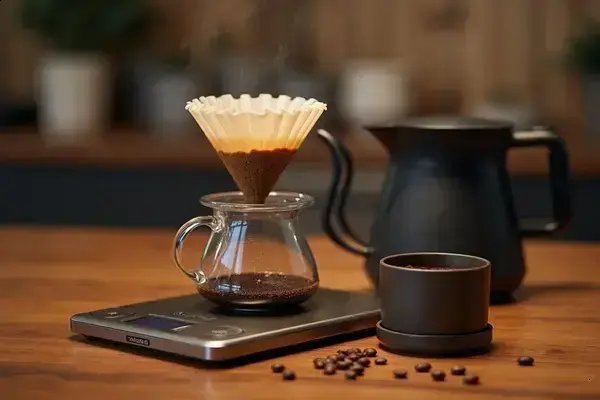
- Prep Your Gear: Place the dripper and carafe or cup on your scale. Tare so your display reads zero. Insert and rinse the filter for a clean cup.
- Weigh The Grounds: Add your ground coffee to the filter. For a standard 350ml mug, weigh out 22g of coffee (adjust to taste).
- Zero The Scale: With your grounds in place, hit tare again. Now you’re ready to measure just the water weight—no math needed.
- Bloom: Pour about twice the weight of your coffee in water (e.g., 22g coffee = 44g water). Wait 30-45 seconds so gases escape and aroma opens up.
- Continue Pouring: Pour water slowly in circles until you reach your total water weight (e.g., 352g for a 1:16 ratio). Keep your pace steady for even extraction.
- Finish & Enjoy: Remove the dripper and swirl your cup to blend flavors. Assess the taste—acidity, body, and sweetness. Tweak next time for your dream cup.
In practice: One reader used to dread his “good cup chase,” frustrated that no two mugs quite matched. After following this measured approach, his results were so reliable that he felt like a barista in his own kitchen.
And this is exactly where most people make the most common mistake…
Troubleshooting: What To Do When The Brew Isn’t Right
Ever sipped your freshly brewed pour over, eyes full of hope, only to be greeted by bitterness, thinness, or flavors that feel off? You’re not alone. Even with a scale, there are moments when a cup just misses the mark—so let’s fix that.
- Bitter Coffee: Usually a sign of over-extraction. You may be using water that’s too hot or letting the coffee steep too long. Try coarser grounds and shorten your pour time by 10-20 seconds.
- Weak Coffee: Under-extracted brews come from too coarse a grind, too little coffee, or too quick a pour. Adjust by increasing your grounds by 1-2 grams or switching to a slightly finer setting on your burr grinder.
- Sour or Sharp Notes: Water under 195°F often leads to acidic, unbalanced flavors. Double-check your kettle’s temp—most home brewers find 200°F (93°C) is the sweet spot.
💡 Pro Tip: The National Coffee Association recommends logging ratios, grind setting, water temp, and pouring speed for each brew. Tiny tweaks can transform a flat cup into something spectacular.
Quick Troubleshooting Table
| Problem | Likely Cause | Try This Fix |
|---|---|---|
| Bitter, harsh aftertaste | Too much extraction | Grind coarser, lower temp, pour faster |
| Watery or flat | Too little extraction | Increase ratio, finer grind, pour slower |
| Sharp, sour flavors | Water too cool | Heat water to 200°F / 93°C |
Picture this scenario: You make a cup that’s bland, tweak one variable—say, grind finer by a notch—and the next brew sings with sweetness and clarity. That’s the magic of dialing in. Every great barista, from Blue Bottle to La Marzocco, keeps a notebook or brewing app for exactly this reason.
The right habits in place now make everything easier from here.
Every Cup Now In Your Control
If you take just one thing from this coffee scale guide pour over, let it be: weighing your coffee isn’t about being fancy—it’s the subtle switch that brings consistency and amazing flavor to every single cup. Remember precision with a scale, knowing common mistakes, and quick troubleshooting make you the boss of your brew.
Before, every pour over was a gamble—sometimes great, sometimes disappointing. Now, you’re set for café-level results at home. Brewing is suddenly simple, repeatable, and satisfying. It’s really just about a tiny bit of care at the start—your coffee tastes better for it.
What’s the first thing you’ll try with your scale—more precise ratios, a new timer, or maybe dialing in your grind? Jump to the comments and share your next experiment!

Ethan Cole Hargrove is a pour over coffee enthusiast, specialty coffee writer, and the founder of this blog — built for anyone who has ever tasted a truly great cup of coffee and wanted to understand exactly how to make it at home.
Ethan’s coffee journey started the way most do — with a supermarket blend and a cheap drip machine. Then one morning at a specialty café, a barista handed him a pour over and everything changed. The clarity, the complexity, the way the same bean could taste completely different depending on how you brewed it. He was hooked.
What followed was years of testing every dripper, grinder, kettle, and filter he could get his hands on. Comparing Chemex vs V60 vs Kalita. Dialing in grind size by the click. Learning why water temperature matters more than most people think. Building a morning ritual around a process that is as meditative as it is delicious.
Ethan is not a Q Grader, certified barista, or